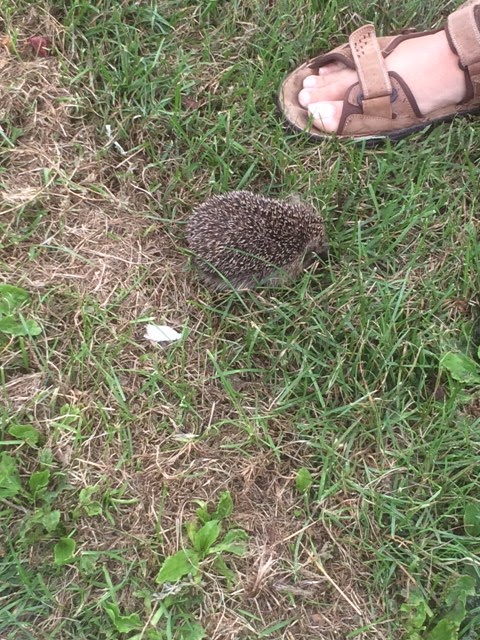
I once saw hedgehogs quite frequently in and around my garden but I have not seen one for many year (just the occasional road casualty).
So I was really pleased to see this hedgehog on our front garden last night. It was sitting in the lawn looking towards the house.
My wife took out some cat food and the hedgehog came over a eat some of the cat food before heading off into the over-gown flower border in search of some tasty invertebrates.
Hedgehogs have declined drastically and while the exact reason is unknown intensification of agriculture, roads, pesticides and tidy gardens may all play a part. As with many species declines its often a mixture causes.
Connectivity of habitats is also important, even more so for hedgehogs as they may roam 1-2 km in a single night. Our neighbours have had a hedgehog family in their garden for a while. After 8 weeks the young are left to fend for themselves and this is likely to be one of the young hogs.
If you put food out, hedgehogs tend to visit for a top up and still feed on the natural food - so its not a problem. Avoid fish based catfoods as it can give hedgehogs diarrhoea. You can also add meal worm and other tasty treats as hedgehogs are omnivores. You can also provide a bowl of water as drinking water is often hard to find.
While hedgehogs can swim well, if they fall in a swimming pool or raised pond with no area to climb out, a hedgehog will eventually become exhausted and drown. An untidy overgrown area is also perfect for a hedgehog to visit on its travels.
Showing posts with label sussex. Show all posts
Thursday, 17 August 2017
Saturday, 15 July 2017
Herring gull mobbing buzzard
The herring gull chicks have taken to wandering around on the roof tops and some have even taken to the air. The adults are much less tolerant of potential intruders including the occasional buzzard that glides over our garden.
Several gulls wheel around with raucous cries while one herring gull repeatedly mobs the buzzard until it has been chased out of range.
Labels:
Brighton,
buzzard,
herring gulls,
mobbing,
sussex,
urban birds
Monday, 15 May 2017
Returning swifts
For me, summer begins when the swifts return to nest under the eaves of our neighbours house. Unfortunately we live in a bungalow and it too low to attract swifts.
The swifts spend the winter south of the Savannah in Africa. The return to the UK last week in April or early May. In previous years I have usually seen the first arrivals by 4th May but this year they were a little late.
Swifts traditionally nested in rocky crags, sea-cliffs, caves, hollow trees and even nest holes made by other birds. Now most swifts nest in buildings, which has allowed them to colonise many new areas.
We usually have three pair nest in our neighbours property. Once the chicks have hatched the adults collect large amounts of insect food in the air, preferably at heights over 50 m, collected in a special food pouch.
Their ariel acrobatics area joy to watch and they often sweep low over our garden - low enough to touch (but of course I don't)
Labels:
garden wildlife.,
sussex,
swifts,
swifts nesting
Wednesday, 15 February 2017
Frogs return to my pond
I awoke this morning to loud croaking chorus from our pond heralding the frogs return following hibernation.
The pond is just outside the conservatory window and the frogs notice the smallest movement at the window - but definitely 13 frogs at the moment
Courtship in full swing as they are already jostling to form pairs.
The female common frogs are often a bit larger than the male and the female has a darker throat, while the male’s throat is often white.
The pond is just outside the conservatory window and the frogs notice the smallest movement at the window - but definitely 13 frogs at the moment
Males and females common frogs look the same but there are a few clues you can look for.
Monday, 13 February 2017
Goldcrest visiting my bird feeder
A pleasant surprise visitor to my bird feeder - a Goldcrest. Smaller than a wren, along with the firecrest, the goldcrest is our smallest bird.
I noticed the goldcrest in the branches of the buddleia and it eventually came down onto the feeding tray of my bird feeder picking up tiny bits of food that had been dropped by sparrows and tits feeding on the fat balls.
The goldcrests plumage is olive above and buff white below, with darker wings displaying two white wing bars and an orange or yellow crown stripe flanked by a black edge.
Adult males have an orange or orange-yellow crown stripe, in the female the stripe is yellow. In the photographs the head stripe appears to be orange so this goldcrest is probably a male. Looking at the video the crest looks more yellow - but maybe due to poor light and damp windows.
After clearing up all the scraps from the feeding tray, the goldcrest flew back up into the buddleia and after a few seconds surprised me by flying onto the birdfeeder and eating tiny bits from the fat balls.
I noticed the goldcrest in the branches of the buddleia and it eventually came down onto the feeding tray of my bird feeder picking up tiny bits of food that had been dropped by sparrows and tits feeding on the fat balls.
The goldcrests plumage is olive above and buff white below, with darker wings displaying two white wing bars and an orange or yellow crown stripe flanked by a black edge.
Adult males have an orange or orange-yellow crown stripe, in the female the stripe is yellow. In the photographs the head stripe appears to be orange so this goldcrest is probably a male. Looking at the video the crest looks more yellow - but maybe due to poor light and damp windows.
After clearing up all the scraps from the feeding tray, the goldcrest flew back up into the buddleia and after a few seconds surprised me by flying onto the birdfeeder and eating tiny bits from the fat balls.
Goldcrests are largely insectivores so I was surprised to see it on the bird feeder
In winter I have observed the occasional goldcrest foraging for food in the evergreen passion flower in our back garden but never seen on the bird feeder before.
Monday, 23 January 2017
magpie eating ice cystals
Another of those icy foggy days. Magpie back at the bird feeder early this morning but could not get a drink as the bird bath was frozen and I had not yet had the chance to defrost it.
The magpie flew up onto the roof of our neighbours shed and was using its beak to scratch off and 'eat' the frost that covered the roof of the shed.
Not long after I tipped boiling water into the two bird and separate water bowl to melt the ice and then refilled, tipping in a little of the boiling water to make the water a bit warmer and less likely to refreeze.
Although we have few actually snowy days, there are many days when standing water is frozen and limiting places where birds can get a drink.
The magpie flew up onto the roof of our neighbours shed and was using its beak to scratch off and 'eat' the frost that covered the roof of the shed.
Not long after I tipped boiling water into the two bird and separate water bowl to melt the ice and then refilled, tipping in a little of the boiling water to make the water a bit warmer and less likely to refreeze.
Although we have few actually snowy days, there are many days when standing water is frozen and limiting places where birds can get a drink.
Labels:
Brighton,
Garden birds,
magpie eating ice,
Portslade,
sussex
Sunday, 22 January 2017
Clever magpie
Magpie demonstrates its a member of the crow family by overcoming the problem of getting food from one of my 'fat ball' bird feeders.
First attempts were from the left hand side of the bird feeder - stretching from the very bendy outer branches of the adjacent buddleia bush, just as his beak touched the fat ball the magpie would over balance and fall off.
The magpie gave up for a while and found small food items underneath the bird feeder - that had been dropped by the sparrows and blue this that visit the feeder.
When the magpie could not find any more food on the ground - it tried again to tackle the bird feeder, from different positions and eventually found a way to reach the food.
First attempts were from the left hand side of the bird feeder - stretching from the very bendy outer branches of the adjacent buddleia bush, just as his beak touched the fat ball the magpie would over balance and fall off.
The magpie gave up for a while and found small food items underneath the bird feeder - that had been dropped by the sparrows and blue this that visit the feeder.
When the magpie could not find any more food on the ground - it tried again to tackle the bird feeder, from different positions and eventually found a way to reach the food.
Sunday, 16 October 2016
Pond Clean Discoveries
Started Autumn management of our pond this weekend preparing it for winter. Pleasantly surprised to find both damselfly and dragonfly nymphs in the pond.
Along with the larger nymphs from last year - there were also tiny damselfly nymphs which would have hatched from this years mating and egg laying.
Great surprise to find several dragonfly nymphs as well. I have not had dragonflies lay eggs in the pond before so this was a great find. These were tiny and also would have been the result of this years mating and egg laying.
I have seen adult dragonflies in the front garden and the nearby track most years. There was a dragonfly in the front garden a lot earlier in the summer. As adult dragonflies often lay their eggs once the male and female had separated- a female must have found the pond and laid eggs.
The paired damselflies are very visible each summer in and around our pond.
Images above captured through usb microscope cam
Along with the larger nymphs from last year - there were also tiny damselfly nymphs which would have hatched from this years mating and egg laying.
Great surprise to find several dragonfly nymphs as well. I have not had dragonflies lay eggs in the pond before so this was a great find. These were tiny and also would have been the result of this years mating and egg laying.
I have seen adult dragonflies in the front garden and the nearby track most years. There was a dragonfly in the front garden a lot earlier in the summer. As adult dragonflies often lay their eggs once the male and female had separated- a female must have found the pond and laid eggs.
The paired damselflies are very visible each summer in and around our pond.
Images above captured through usb microscope cam
Labels:
damselfly nymph,
dragonfly nymph,
garden pond,
sussex
Friday, 16 September 2016
Ivy Bees
On my way to the shops on Wednesday and I noticed hundreds of solitary bees zig zagging back and forth just above the ground in a front garden. The grass was very closely mowed.
The buzz from the bees was quite loud. I noticed that the bees were also present in three adjacent gardens with similar gardens.
I went home for my camera and took a few pics. I later identified the bees at Ivy bee (confirmed by BWARS - Bees Wasps Ants Recording Society).
These solitary bees have a single flight period, September and possibly as late as November when the weather is warm. This coincides with their preferred pollination source - Ivy.
This bee was first seen in the UK in 2001 (Dorset) and was described as new to science in 1993.
I returned to see if they were still their yesterday and they were just as active. Ivy Bees are mining bees making nest tunnels, in this case, in the soil beneath the lawn.
I checked today and even though it had been raining and quite windy, a few of the bees were still evident
Short video clip below
Labels:
garden wildlife,
Ivy bees,
Portslade,
solitary bees,
sussex
Sunday, 11 September 2016
Hedgehog rescue Portslade
Driving to visit my mum and we had not gone far when we saw a small hedgehog crossing the road - thankfully the car opposite had stopped to let it crossed.
We pulled over and I we went to check on the hedgehog which was on the verges side. I stood between it and the road to encourage the hedgehog to toddle off into one of the nearby gardens.
It seemed quite happy on the verge. While it was active during the day, it did seem to be healthy and behaving normally. Maybe the recent dry hot weather has made it difficult for the hog to find enough food.
It then started to make its way back towards the road and so I carefully picked it up and it rolled into a ball.
We decided it was best to find somewhere to put it safely - and after knocking on two doors and di not get an answer we got a reply. A gentleman was more than pleased for us to put the hedgehog in his back garden and told us he already had two adult hedgehogs that visited his garden in the evening.
Hopefully the hedgehog will stand a better chance there away from the busy road but still in an area that was familiar - because sadly hedgehogs are on the decline.
Pictures taken by my daughter with her mobile phone
We pulled over and I we went to check on the hedgehog which was on the verges side. I stood between it and the road to encourage the hedgehog to toddle off into one of the nearby gardens.
It seemed quite happy on the verge. While it was active during the day, it did seem to be healthy and behaving normally. Maybe the recent dry hot weather has made it difficult for the hog to find enough food.
It then started to make its way back towards the road and so I carefully picked it up and it rolled into a ball.
We decided it was best to find somewhere to put it safely - and after knocking on two doors and di not get an answer we got a reply. A gentleman was more than pleased for us to put the hedgehog in his back garden and told us he already had two adult hedgehogs that visited his garden in the evening.
Hopefully the hedgehog will stand a better chance there away from the busy road but still in an area that was familiar - because sadly hedgehogs are on the decline.
Pictures taken by my daughter with her mobile phone
Monday, 7 March 2016
Protecting frog spawn from the cold weather
As you will know from an earlier post, the frog spawn laid in my pond back in early February suffered from being frozen at the surface.
Since then many more frogs have returned to the pond and there is now lots of frog spawn.
In cold weather, I lay a black bag carefully over the spawn near the edge of the pond and it is enough to keep the water and spawn from freezing
Since then many more frogs have returned to the pond and there is now lots of frog spawn.
In cold weather, I lay a black bag carefully over the spawn near the edge of the pond and it is enough to keep the water and spawn from freezing
Labels:
garden pond,
Portslade,
protecting frog spawn,
sussex
Saturday, 5 March 2016
Peacock butterfly
The first peacock butterfly in my garden this year. It was actively flying around before I manage to get his photo as it rested on a bag of garden rubbish (waiting to be recycled).
Peacock butterflies hibernate in the winter. They hibernate because of a lack of food (flowering plants also become dormant) and warmth, butterflies are cold blooded.
When the butterflies are dormant, their bodies use very little energy.
Peacock butterflies hibernate in the winter. They hibernate because of a lack of food (flowering plants also become dormant) and warmth, butterflies are cold blooded.
When the butterflies are dormant, their bodies use very little energy.
Sunday, 21 February 2016
Robin eating the fat balls
Its been a rather wet and windy day and so I did not put any of the mealworm on the bird feeder station as they would easily blow away.
Surprised today to see a robin (who visits for the mealworm), eating fat balls form the dispenser, balancing on a adjacent branch
Saturday, 20 February 2016
Common Frogs Return
After the pond froze yesterday I was really surprised to wake up this morning to a pond full of writhing frogs.
Too many to count at the moment as they dive at the slightest twitch of the curtain, but we often get 30 -40 frogs a year.
Many of these frogs have travelled from outside of our garden.
This one was crossing the pavement outside our house and open its way to our front gate.
Occasionally they pair up even before the reach the pond (which is in our back garden) such as this pair
Any I find on the way to the pond I give a helping hand and will be keeping an eye out over the next few days. Last year I found a couple of frogs who had not managed to reach the pond and died - so I now give them a hand
Too many to count at the moment as they dive at the slightest twitch of the curtain, but we often get 30 -40 frogs a year.
Many of these frogs have travelled from outside of our garden.
This one was crossing the pavement outside our house and open its way to our front gate.
Occasionally they pair up even before the reach the pond (which is in our back garden) such as this pair
Any I find on the way to the pond I give a helping hand and will be keeping an eye out over the next few days. Last year I found a couple of frogs who had not managed to reach the pond and died - so I now give them a hand
Friday, 19 February 2016
Frozen frog spawn
I looked out the window this morning and noticed that the pond had frozen over.
This could be disastrous for the frog spawn in the pond that was laid in my pond 8th February when the weather was mild as the spawn can be affected by cold weather.
The layer of ice forms covering the surface of the spawn could cause the upper layer of eggs to die. However it is a big clump of eggs and those in the middle and bottom of the spawn may survive.
Frog spawn development slows down when its cold so I will have to wait and see what occurs. In March, frogs from further afield will usually visit my pond and so there will probably be lots more spawn to look forward to.
Labels:
amphibians,
frozen frog spawn,
garden pond,
ice,
sussex
Monday, 12 October 2015
Comma butterfly sunbathing
A very warm Sunday afternoon and I spotted this comma butterfly sunning itself on our flint wall.
The reason its called a comma is the small white comma shaped mark on the underside of its wings, but it looks a bit like a tatty battered tortoiseshell.
This butterfly overwinters as an adult and must build up their fat reserves to survive the winter. Idea site includes underneath the bark or a tree truck, log pile or maybe a garden shed.
tree trunk, log piles.
The reason its called a comma is the small white comma shaped mark on the underside of its wings, but it looks a bit like a tatty battered tortoiseshell.
This butterfly overwinters as an adult and must build up their fat reserves to survive the winter. Idea site includes underneath the bark or a tree truck, log pile or maybe a garden shed.
tree trunk, log piles.
Friday, 18 September 2015
swallows
Large numbers of swallows and a few house martins flying low and fast over our garden. They came through in twos and threes.
This continued for about 10 minutes and then it poured with rain, so the swallows must have been racing ahead of the storm.
I often see house martins and swifts locally but swallows no longer appear to nest locally but I often see them on their return migration.
This continued for about 10 minutes and then it poured with rain, so the swallows must have been racing ahead of the storm.
I often see house martins and swifts locally but swallows no longer appear to nest locally but I often see them on their return migration.
Sunday, 30 August 2015
Juvenile slow worm
The pavement outside out garden had become quite overgrown with grass and other vegetation.
I decided to clear the pavement and to my surprise found a very small slow worm curled up in one of the small clumps of grass I pulled up.
I carefully placed the clump of grass plus slow worm into a overgrown corner of the garden. My wife found a juvenile slow worm in the garden a few days ago and adult slow worms turn up every now and again.
Saturday, 22 August 2015
Yellow field ant nuptial flight
Yellow field ant nuptial flight started at just after 6.00pm. I had noticed over the last couple of weeks that there were two very small soil piles made by any in the front garden and two on the grass verge outside of the garden.
I knew we had a small yellow field ant colony in our front garden, but far out numbered by the black ants. I first noticed the nuptial flight when a flying ant landed on the book I was reading.
I looked up and noticed a few more ants in the air.
The yellow ant flight was much smaller than the black ant nuptial flights reported earlier.
I knew we had a small yellow field ant colony in our front garden, but far out numbered by the black ants. I first noticed the nuptial flight when a flying ant landed on the book I was reading.
I looked up and noticed a few more ants in the air.
The yellow ant flight was much smaller than the black ant nuptial flights reported earlier.
Labels:
field ant nuptial flight,
sussex,
yellow field ant
Tuesday, 4 August 2015
Fox and Pipistelle Bat
Just before 9.00am I noticed a fox hunting in the track. It traveled nose to the ground crossing the track and looking in the vegetation, slowly making its way towards our house. I quickly went inside to get my camera.
I knew the flash would probably cause the fox to head back up teh track so I waited until it was near enough to take a photo.
The flash caused the fox to freeze and it looked in my direction, but not sure if it could see me as I kept myself in front of our brick wall. It turned slowly and trotted back up the track.
Foxes were quite common around our way and in previous years I have watched a couple of foxes on their nightly rounds, but I have not seen them for a couple of years, so great to see this fox.
Just after the fox had gone, I noticed the pipistrelle bats were also now on the wing. Again, I have been watching these bats hunting along the track for the last few years. There are lots of insects in the track and the bats may hunt for a 20 minutes or more before moving on. I watched them for a while then went inside.
A short while later I went back out to check and as I suspected, the fox was back hunting again. I knew that my presence would only cause it to go away temporarily
I knew the flash would probably cause the fox to head back up teh track so I waited until it was near enough to take a photo.
The flash caused the fox to freeze and it looked in my direction, but not sure if it could see me as I kept myself in front of our brick wall. It turned slowly and trotted back up the track.
Foxes were quite common around our way and in previous years I have watched a couple of foxes on their nightly rounds, but I have not seen them for a couple of years, so great to see this fox.
Just after the fox had gone, I noticed the pipistrelle bats were also now on the wing. Again, I have been watching these bats hunting along the track for the last few years. There are lots of insects in the track and the bats may hunt for a 20 minutes or more before moving on. I watched them for a while then went inside.
A short while later I went back out to check and as I suspected, the fox was back hunting again. I knew that my presence would only cause it to go away temporarily
Subscribe to:
Posts (Atom)