Thursday, 2 December 2010

A walk in the snow


After the heavy snow during the night, the ground is now covered with a thick layer of snow, about 8 inches, more than we had last year. At 10.00am I went for a walk around the village to see what bird and animal life was about. I walked up the track but only encountered a few birds.
A small flock of sparrows were chattering in a snow covered bush.
Many birds, including crows, pigeons and starlings gathered around chimney pots for an extra bit of warmth.
A few redwing flew over, but too quick for my camera to focus. A solitary blue tit foraged in a tree.

At the end of the tack I turned left and left again taking me down the road to my house. As yesterday, I carried on past the house towards the old village. I saw three pied wagtails at different locations, bobbing their tail as they walked along in the snow.

 A passer by disturbed one and it flew up onto a roof top.

As I walked up towards Easthill Park I noticed movement in the branches. It was a tiny goldcrest, the smallest of our UK song birds.
As I watched I noticed a great tit higher up in the branches and the read breast of a robin. The goldcrest was very active and at one point was close enough for me to touch.

As I watched a squirrel bounded past in the snow and scampered

The snow in Easthill park was very thick, The horses next door in the horse sanctuary did not seem bothered by the snow.
Even thought plenty food had been provided for the horses, this one was eating foliage from a tree. A few birds visible, mainly pigeon, crow and a few starlings. The occasional herring gull also flew past.

I trudged through the thick snow to the wooded end of the park where there is a pathway through the trees. 
As I walked along the odd blackbird and blue tit flashed past. At the far end, another pied wagtail. 
I left the wooded path and was about to walk down the outside of the wooded area when I spotted a blackbird. It was feeding on berries.
It was soon joined by another male blackbird and a squabble broke out.


The squabble was short lived and one of the blackbirds flew away, possibly the intruder but it was as hard to follow as the magicians find the queen or the ball under the cup. The bird that remained started to eat the berries.
As I started to walk alongside the wooded area I spotted a red wing
 I carried on walking and as I passed underneath a particular large evergreen a flash of blue attracted by attention it was a blue tit. Then I spotted a great tit.
Many more appeared to be foraging in the higher branches occasionally sending down a small shower of snow.

I was then attracted by another small bird which I thought was another goldcrest. But looking at the photographs back home on the computer I think it might have been the rarer firecrest. (comments welcome)
As I walked back through the old village I noticed this female blackbird feeding on then berries from a garden.

Wednesday, 1 December 2010

Foxes in the snow

Following the small amount of snow we had yesterday, the continuous dusting of snow all day has built up to a more substantial amount. I gave my mum a call to check she was okay and she said it had just started to snow heavily.
I looked out the window and saw movement down the dirt track next to our house. At first I thought it was a cat but soon discovered it was a fox. In fact it was two foxes, chasing each other across the track. At one point they reared up onto their hind legs, sparing with their fore paws. If I had not telephoned my mum and looked out the window at that moment I would not have noticed them. Although this seemed to be early courtship, there was no calling which would normally occur. Also, without the snow, I would not have seen them either. The foxes disappeared up the far end of the track.

I kept an eye out and about 30 minutes later I saw one fox in the track. It appeared to be hunting, occasionally pouncing. I took a few pictures (without flash, after dark – only possible because of the snow).


Then the batteries ran out, just as the fox appeared about 5 meters from my window. I changed the batteries and looked out the window, just in time to see the fox running back across the road and disappeared behind the tall flint wall and disappeared up the road.

After a few minutes I decided to follow the tracks (my daughter came with me) and see where they led.
I could see where the fox crossed the road and where the tracks led off up the path.

About 50m further, the tracks crossed the road and disappeared between two houses to a back access alley. The prints led to a low wall, the fox appeared top have negotiated this and entered the back garden of a house on the adjacent road.

We carried on up the road and turned of up a short track that turned right again leading back top the track that leads back to our house.
A few meters along and we disturbed a bird that was sheltering in the shadows on the ground. It flew up and headed away from us. I had the impressing of a largish (small chicken size) bird with a long beak. It looked like a woodcock!

We walked along the track and pass our house in the hope of encountering the bird again, but did not see any sign.
We carried on a short distance to the high street, by now the snow was really heavy and the glow of the lights on the snow made the scene rather eerie.


Tuesday, 9 November 2010

Wasps

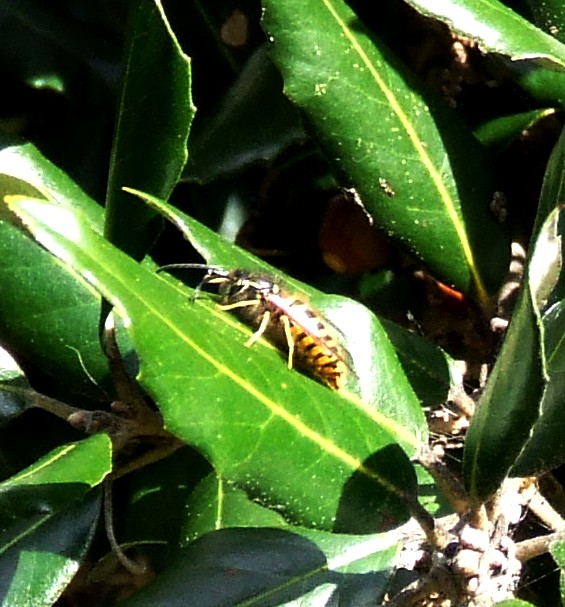
During the sunny days, over the last week or so, I have noticed a lot of wasp activity around the oak (species) tree that over hangs our garden. The wasps are mainly high up, buzzing around the branches, occasionally flying off.


Today I managed to get a relatively close up picture of a couple of the wasps. I think they might be the German Wasp, because of the hairy head and thorax. The yellow marking on the face in this species also bears three black dots, but none of the pictures were clear enough to show this. These wasps make a nest made from chewed up plant fibers and produce a chemical which repels ants, which the secret at the base to prevent ants invading the nest.
What was particularly strange is that a few metres away, an apple tree overhangs our garden. On the shed roof is a pile of windfall apples and yet the wasps showed no interest in them.

Like the common wasp, these worker wasps collect insects and caterpilars to feed their young (earlier in the year) and so these an benificial insects

Monday, 8 November 2010

Winter bees

 A sunny weekend and the odd bumble bee is still active in my back garden, visiting the Hebe. I also noticed one checking out flowers in the front garden too.

I heard recently that scientists are investigating the growing phenomenon of bumblebees remaining active throughout the winter. They believe this may be due to the recent warmer winters, linked to climate change, also our passion for gardening. With the increasing popularity of exotic plant species and winter flowering shrubs, flowering plants are available in the winter from which bees can collect food. The species they have been monitoring is the buff-tailed bumble bee.

Another theory being explored is that the bees may be hybridising with foreign bees, which remain active in winter. It is thought that these may have escaped into the wild after being imported into Britain to help with the pollination of crops in poly tunnels.
The "winter bees" seem to be an entirely urban or suburban phenomenon. It appears that the queen bee only goes into a mini hibernation in October and then starts foraging again, rather than sleeping through the winter and waking up in March. However this could leave these bees
particularly vulnerable and a severe cold snap could be devastating to a species that is already struggling.

Sunday, 7 November 2010

Yellow Iris Seed Pods

The seed pods of the yellow iris growing in my pond have started to split open.
Autumn is a great time for taking arty shots of nature as it prepares for the winter

Friday, 5 November 2010

Jays

Jays love acorns and this often leads to some quite close observation of this relatively shy, colourful member of the crow family.
I have seen and heard a jay in the oak tree that over hangs our garden on and off for the last couple of weeks.
Today however there a great commotion as three jays chased each other back and forth from the tree to the garage roof.

No need to fight over the acorns as there are more than enough to go around - even for the wood pigeons that also visit the tree.

Eventually there was only one left.
Jays frequently bury acorns and dig them up later.I have noticed small holes in our front lawn and had previously blamed squirrels, but this may have been caused by jays retrieving their stash of acorns.

Jays have a rather bad reputation as like other members of the crow family they will also feed on the nestlings of other birds