Monday, 18 July 2016


It’s that time of year when the flying ants take to the sky, new queens and males on their nuptial flight.  


The Royal Society of Biology (formerly the Society of Biology) have been running a flying ant survey in collaboration with the University of Gloucestershire between 2012 and 2014 and I have provided my records for this survey.  As with 2015, this year, the survey is more informal but society is keen to receive reports, find out more at https://www.rsb.org.uk/get-involved/biologyweek/flying-ant-survey
The main flying ant nuptial flight in and around my garden took place on 18th July.


The main nest on our rockery 


Smaller nest in our front garden

A small nest under the pavement just outside our garden. 

As always many were eaten by birds including gulls that catch them, on the wing and also pick them of the ground. Some become entangled in spider webs before they get far from the ground.

The nuptial flight this year is earlier than last year which took place 31st July and 2nd   August

Friday, 8 July 2016

garden wildlife update

Phew! what a busy year and apologies for the fact there have not been any posts since March. This has been due to working on a nature reserve in Lewes Sussex - a former railway yard that has now become a community environmental hub in the form of a
Local Nature Reserve served by an innovative community building.


There is a small woodland, winterbourne stream, reed bed, ditches, water meadows and two ponds. The project I have been working on, as lead field teacher and lead freshwater biologist, called Railway Land Live can be seen here  http://www.railwaylandlive.org/ and you can also ready my nature posts tab 'places to think' for the project.


Meanwhile, in my garden, the tadpoles have now turned to frogs and lots more. Bees are busy visiting the garden, red mason bees have again nested in our bee hotel. Not many birds around at the moment as they are elsewhere rearing young etc - but will return last summer to autumn.


The swifts are gain nesting in the roof space of the house next door. Hering gull chicks are beginning to wander causing commotion as their parents try to defend them against any possible perceived danger.

Saturday, 19 March 2016

Bee activity

The warmer weather has seen an increase in bee activity in my garden.


In particular on the grape hyacinth which are very common in our garden. They have been visited by hoverfly and honey bees (below)


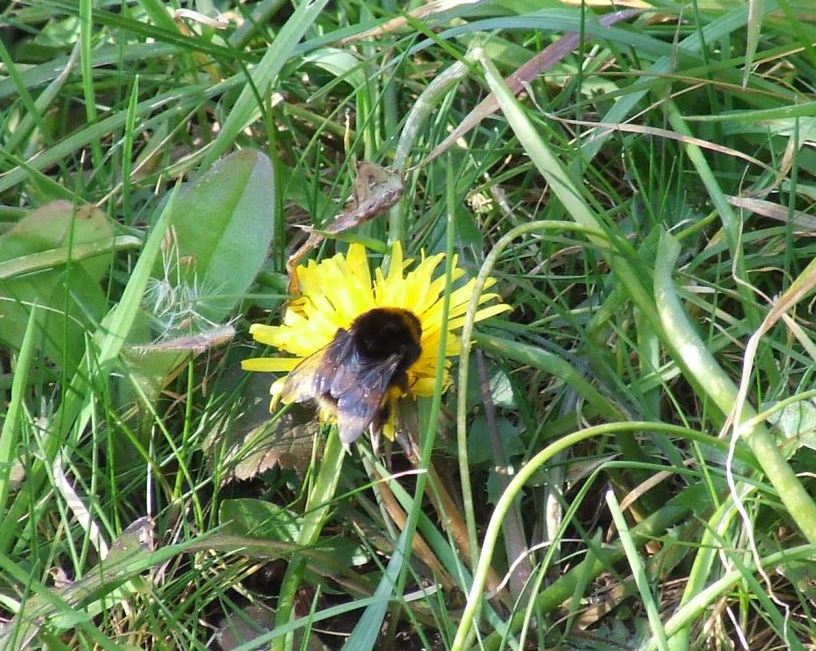
I even saw my first queen buff tailed bumble bee, also visiting the grape hyacinth and also a dandelion flower

I have also seen male and female hairy footed bees

Monday, 7 March 2016

Protecting frog spawn from the cold weather

As you will know from an earlier post, the frog spawn laid in my pond back in early February suffered from being frozen at the surface.

Since then many more frogs have returned to the pond and there is now lots of frog spawn.
In cold weather, I lay a black bag carefully over the spawn near the edge of the pond and it is enough to keep the water and spawn from freezing

Saturday, 5 March 2016

Peacock butterfly

The first peacock butterfly in my garden this year. It was actively flying around before I manage to get his photo as it rested on a bag of garden rubbish (waiting to be recycled).
Peacock butterflies hibernate in the winter. They hibernate because of a lack of food (flowering plants also become dormant) and warmth, butterflies are cold blooded.

When the butterflies are dormant, their bodies use very little energy.

Sunday, 21 February 2016

Robin eating the fat balls

Its been a rather wet and windy day and so I did not put any of the mealworm on the bird feeder station as they would easily blow away.
Surprised today to see a robin (who visits for the mealworm), eating fat balls form the dispenser, balancing on a adjacent branch


Saturday, 20 February 2016

Common Frogs Return

After the pond froze yesterday I was really surprised to wake up this morning to a pond full of writhing frogs.
Too many to count at the moment as they dive at the slightest twitch of the curtain, but we often get 30 -40 frogs a year.


Many of these frogs have travelled from outside of our garden.
This one was crossing the pavement outside our house and open its way to our front gate.
Occasionally they pair up even before the reach the pond (which is in our back garden) such as this pair

Any I find on the way to the pond I give a helping hand and will be keeping an eye out over the next few days. Last year I found a couple of frogs who had not managed to reach the pond and died - so I now give them a hand