Another of those icy foggy days. Magpie back at the bird feeder early this morning but could not get a drink as the bird bath was frozen and I had not yet had the chance to defrost it.
The magpie flew up onto the roof of our neighbours shed and was using its beak to scratch off and 'eat' the frost that covered the roof of the shed.
Not long after I tipped boiling water into the two bird and separate water bowl to melt the ice and then refilled, tipping in a little of the boiling water to make the water a bit warmer and less likely to refreeze.
Although we have few actually snowy days, there are many days when standing water is frozen and limiting places where birds can get a drink.
Monday, 23 January 2017
Sunday, 22 January 2017
Clever magpie
Magpie demonstrates its a member of the crow family by overcoming the problem of getting food from one of my 'fat ball' bird feeders.
First attempts were from the left hand side of the bird feeder - stretching from the very bendy outer branches of the adjacent buddleia bush, just as his beak touched the fat ball the magpie would over balance and fall off.
The magpie gave up for a while and found small food items underneath the bird feeder - that had been dropped by the sparrows and blue this that visit the feeder.
When the magpie could not find any more food on the ground - it tried again to tackle the bird feeder, from different positions and eventually found a way to reach the food.
First attempts were from the left hand side of the bird feeder - stretching from the very bendy outer branches of the adjacent buddleia bush, just as his beak touched the fat ball the magpie would over balance and fall off.
The magpie gave up for a while and found small food items underneath the bird feeder - that had been dropped by the sparrows and blue this that visit the feeder.
When the magpie could not find any more food on the ground - it tried again to tackle the bird feeder, from different positions and eventually found a way to reach the food.
Wednesday, 7 December 2016
winter butterfly
Another warm spell and noticed this tortoiseshell sunning itself on the west facing wall of our bungalow.
Labels:
Sussex.,
Tortoiseshell butterfly,
winter butterfly
Thursday, 27 October 2016
Acrobatic House Mouse
I watched this acrobatic house mouse outside my window feeding on the fruits of out passion flower.
It was fascinating to watch as he clambered around just outside the window and seeming unaware I was just the other side of the glass.
I have included some video footage below
Better quality footage at
House mice are often treated as vermin - but these tiny mammals are a great example of adaptability. In fact they have colonised much of the planet land mass as they have adapted to us humans.
The house mouse originally came from Asia and spread to Europe 4000 years ago. House mice took advantage of the spread of farming and hitch hiked on ships trading with other countries.
One might also blame mice (and rats) for domestic cats as they were first brought into Europe by the Romans due to the cats 'mousing' skills
Amongst the 44 plus children wildlife books I have written - high up there with the titles I enjoyed writing the most is a book about the humble house mouse.
https://www.amazon.co.uk/Mouse-Animal-Neighbours-Stephen-Savage/dp/0750250844
It was fascinating to watch as he clambered around just outside the window and seeming unaware I was just the other side of the glass.
I have included some video footage below
Better quality footage at
House mice are often treated as vermin - but these tiny mammals are a great example of adaptability. In fact they have colonised much of the planet land mass as they have adapted to us humans.
The house mouse originally came from Asia and spread to Europe 4000 years ago. House mice took advantage of the spread of farming and hitch hiked on ships trading with other countries.
One might also blame mice (and rats) for domestic cats as they were first brought into Europe by the Romans due to the cats 'mousing' skills
Amongst the 44 plus children wildlife books I have written - high up there with the titles I enjoyed writing the most is a book about the humble house mouse.
https://www.amazon.co.uk/Mouse-Animal-Neighbours-Stephen-Savage/dp/0750250844
Sunday, 16 October 2016
Pond Clean Discoveries
Started Autumn management of our pond this weekend preparing it for winter. Pleasantly surprised to find both damselfly and dragonfly nymphs in the pond.
Along with the larger nymphs from last year - there were also tiny damselfly nymphs which would have hatched from this years mating and egg laying.
Great surprise to find several dragonfly nymphs as well. I have not had dragonflies lay eggs in the pond before so this was a great find. These were tiny and also would have been the result of this years mating and egg laying.
I have seen adult dragonflies in the front garden and the nearby track most years. There was a dragonfly in the front garden a lot earlier in the summer. As adult dragonflies often lay their eggs once the male and female had separated- a female must have found the pond and laid eggs.
The paired damselflies are very visible each summer in and around our pond.
Images above captured through usb microscope cam
Along with the larger nymphs from last year - there were also tiny damselfly nymphs which would have hatched from this years mating and egg laying.
Great surprise to find several dragonfly nymphs as well. I have not had dragonflies lay eggs in the pond before so this was a great find. These were tiny and also would have been the result of this years mating and egg laying.
I have seen adult dragonflies in the front garden and the nearby track most years. There was a dragonfly in the front garden a lot earlier in the summer. As adult dragonflies often lay their eggs once the male and female had separated- a female must have found the pond and laid eggs.
The paired damselflies are very visible each summer in and around our pond.
Images above captured through usb microscope cam
Labels:
damselfly nymph,
dragonfly nymph,
garden pond,
sussex
Friday, 16 September 2016
Ivy Bees
On my way to the shops on Wednesday and I noticed hundreds of solitary bees zig zagging back and forth just above the ground in a front garden. The grass was very closely mowed.
The buzz from the bees was quite loud. I noticed that the bees were also present in three adjacent gardens with similar gardens.
I went home for my camera and took a few pics. I later identified the bees at Ivy bee (confirmed by BWARS - Bees Wasps Ants Recording Society).
These solitary bees have a single flight period, September and possibly as late as November when the weather is warm. This coincides with their preferred pollination source - Ivy.
This bee was first seen in the UK in 2001 (Dorset) and was described as new to science in 1993.
I returned to see if they were still their yesterday and they were just as active. Ivy Bees are mining bees making nest tunnels, in this case, in the soil beneath the lawn.
I checked today and even though it had been raining and quite windy, a few of the bees were still evident
Short video clip below
Labels:
garden wildlife,
Ivy bees,
Portslade,
solitary bees,
sussex
Sunday, 11 September 2016
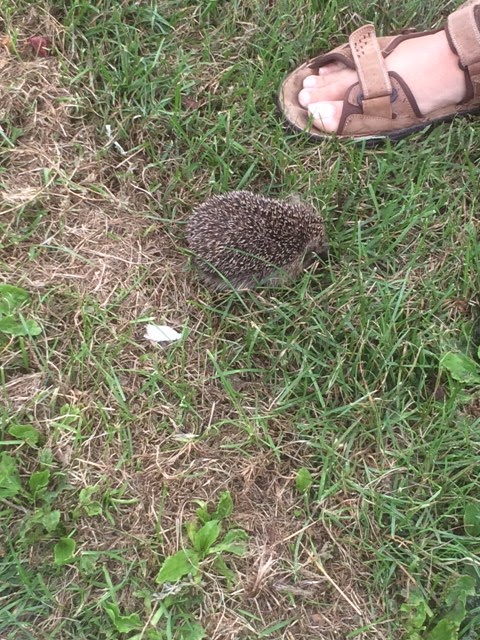
Hedgehog rescue Portslade
Driving to visit my mum and we had not gone far when we saw a small hedgehog crossing the road - thankfully the car opposite had stopped to let it crossed.
We pulled over and I we went to check on the hedgehog which was on the verges side. I stood between it and the road to encourage the hedgehog to toddle off into one of the nearby gardens.
It seemed quite happy on the verge. While it was active during the day, it did seem to be healthy and behaving normally. Maybe the recent dry hot weather has made it difficult for the hog to find enough food.
It then started to make its way back towards the road and so I carefully picked it up and it rolled into a ball.
We decided it was best to find somewhere to put it safely - and after knocking on two doors and di not get an answer we got a reply. A gentleman was more than pleased for us to put the hedgehog in his back garden and told us he already had two adult hedgehogs that visited his garden in the evening.
Hopefully the hedgehog will stand a better chance there away from the busy road but still in an area that was familiar - because sadly hedgehogs are on the decline.
Pictures taken by my daughter with her mobile phone
We pulled over and I we went to check on the hedgehog which was on the verges side. I stood between it and the road to encourage the hedgehog to toddle off into one of the nearby gardens.
It seemed quite happy on the verge. While it was active during the day, it did seem to be healthy and behaving normally. Maybe the recent dry hot weather has made it difficult for the hog to find enough food.
It then started to make its way back towards the road and so I carefully picked it up and it rolled into a ball.
We decided it was best to find somewhere to put it safely - and after knocking on two doors and di not get an answer we got a reply. A gentleman was more than pleased for us to put the hedgehog in his back garden and told us he already had two adult hedgehogs that visited his garden in the evening.
Hopefully the hedgehog will stand a better chance there away from the busy road but still in an area that was familiar - because sadly hedgehogs are on the decline.
Pictures taken by my daughter with her mobile phone
Subscribe to:
Posts (Atom)